

Updated September 2026
A quick summary
To grow a coaching business, you need the same things as any other SME: a clear direction, proper financial control, consistent marketing and sales, useful measures, good systems and an owner who keeps developing. Coaches can be excellent with clients and still neglect some of those things in their own business. The Coaching Star is a useful way to check where the gaps are in your own coaching business.
Take some of your own advice
Ever hear the old phrase “physician, heal thyself”? It still works here.
Business coaches spend a lot of time asking clients whether they have a current plan, whether they know their numbers, whether sales activity is consistent and whether their diary reflects their priorities. It is surprisingly easy to give good advice all week and then realise that your own marketing has slipped or your own business plan has not been looked at for months.
The coaching profession is growing. The ICF’s 2025 Global Coaching Study put the number of coach practitioners worldwide at 122,974, up 15% from 2023. That is encouraging for small business owners, but might not be good news for prospective coaches. In response, coaches need to be clear about how they are going to build a business and have a clear point of differentiation and value, rather than assume experience alone will create demand.
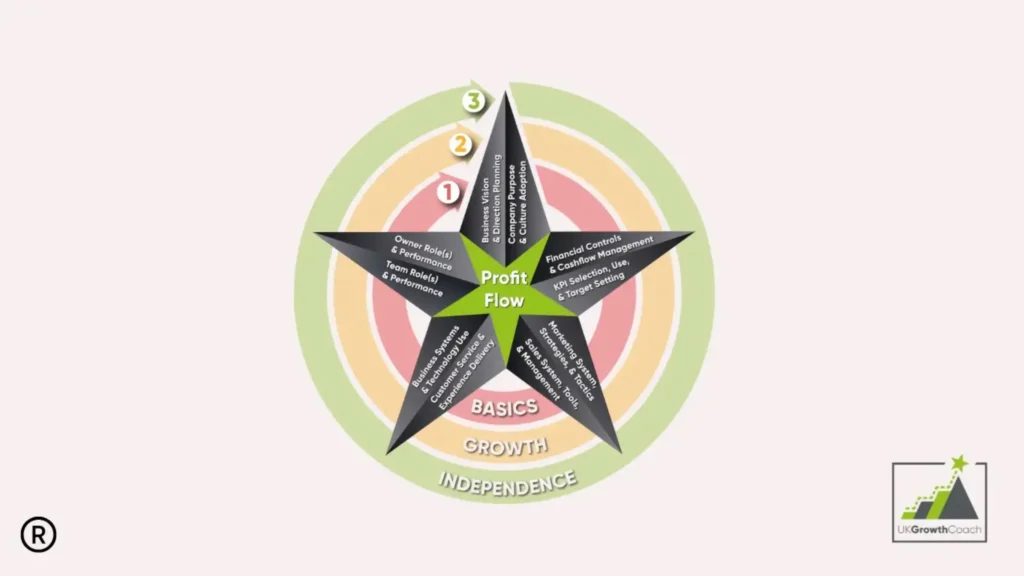
Use the Coaching Star on your own business
At UK Growth Coach, we use the Coaching Star with clients because it forces you to look at the whole business rather than whatever feels most urgent that week. The same applies to a coaching practice.
Start with direction. What sort of coaching business are you trying to build, and what do you want it to give you? If that is unclear, it becomes very easy to accept any work that comes along and call it growth.
Then look at culture and client experience. Even if you are working alone, clients will form a view of how you operate. How organised are you? How quickly do you follow up? What standards do you expect from yourself and anyone supporting you?
Financial controls matter just as much to you as they do for your clients’ businesses. You should know what the business needs to earn, what each service contributes, how much recurring income you have and whether your pricing supports the business you want.
Marketing and sales need regular attention
A lot of coaches are more comfortable delivering coaching than promoting themselves. That is understandable, but it does not remove the need for a proper marketing and sales rhythm.
Who are you trying to reach? What problems do you want to be known for helping with? How regularly are you creating conversations with the right people?
Sales needs similar discipline. A good enquiry can still go nowhere if the follow-up is weak or the sales conversation does not help the prospect understand the value of coaching.
Track and monitor the health of your own business using KPIs. You do not need dozens of measures to do this. Enquiries, qualified prospects, conversion rate, active clients, recurring revenue and retention will tell you a great deal about what is working and what needs attention.
Systems matter as the client base grows
As the client base grows, relying on memory becomes harder.
Lead follow-up, onboarding, session preparation, invoicing, actions and reviews all benefit from a repeatable process. Good systems make the experience better for the client and reduce the amount of admin sitting in the coach’s head.
The same applies to team support. You may begin alone, but over time you might bring in admin help, marketing support or other coaches. Be clear about what genuinely needs you and what someone else could do more efficiently.
Then there is your own performance. Are you still learning? Are you developing your coaching skills, commercial knowledge and confidence? Or have you started relying on what worked a few years ago?
How UK Growth Coach supports franchisees
UK Growth Coach franchisees work with the same principles they use with clients. They receive an 8-day initial training programme, ongoing support, nearly 200 coaching tools and marketing and sales resources to help them build their own coaching business.
That does not remove the responsibility of running the business. It gives you a framework and a set of tools so you are not trying to invent every part of the model while also finding clients and learning how to coach them well. In addition there is the accountability to your mentor coach to ensure you are taking your own advice in order to grow your coaching business and fulfil your ambitions.
If you are considering building your own business coaching practice, the next step is a Discovery Day conversation.

FAQs
How do I grow a business coaching business?
Treat it like a business in its own right. You need a clear target market, regular marketing and sales activity, sensible financial controls, useful KPIs and systems that support the client experience.
Why do business coaches struggle to grow?
A common problem is spending so much time coaching clients that the coach neglects their own sales, marketing, planning or financial management. Knowing what should be done does not automatically mean it gets done consistently.
How do business coaches get more clients?
There is no single channel that works for every coach. Most need a mixture of relationship-building, referrals, networking, marketing activity and direct sales conversations, backed by consistent follow-up.
How should I market my coaching business?
Start with the people you want to work with and the business problems you are well placed to help them address. Your marketing should make that clear and give interested owners a sensible route into a conversation.
Do business coaches need a sales process?
Yes. You need a reliable way to take someone from initial interest through to a useful conversation and, where appropriate, into a coaching relationship. That process should be reviewed and improved like any other part of the business.
What KPIs should a business coach track?
Useful measures can include enquiries, qualified opportunities, conversion rate, active clients, recurring revenue, retention and referrals. Track the measures that help you make decisions rather than collecting data for its own sake.
Does a business coach need a business plan?
Yes. A coach benefits from the same clarity they would encourage in a client. You should know where the business is going, who you want to work with, what you want it to earn and what needs to happen to get there.
How much time should a coach spend on business development?
There is no fixed percentage, but it needs protected time every week. If marketing and sales only happen when client work is quiet, the pipeline will usually become inconsistent.
Can a coaching franchise help me grow my business?
A franchise gives you an established coaching framework, training, tools and marketing and sales support. You still need to build relationships and win clients, but you are starting with more of the business model already in place, and ongoing support and accountability.
How does UK Growth Coach support franchisees?
UK Growth Coach franchisees receive initial training, ongoing support through a dedicated mentor coach, nearly 200 coaching tools and resources covering marketing, sales and client delivery.